Short answer. The Pantheon has three things worth your time: the portico with its sixteen granite columns, the dome with the open oculus, and the tombs, Raphael’s first of all. Outside, the square has a fountain with an Egyptian obelisk, and the church of Santa Maria sopra Minerva is a few steps away.
Tickets, guided visits and walking tours
Pantheon Rome: Entry Ticket + Digital Audio Guide
3.7· 7,723 reviews
from €11.80
Book tickets and tours →What do you see from the square?
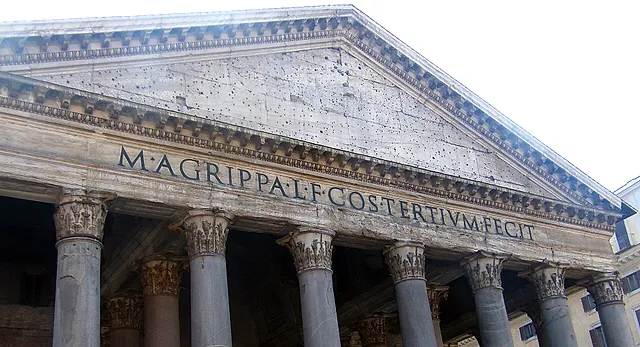
You stop first at the portico. It has sixteen monolithic granite columns, eight across the front, each about 12 metres tall and weighing around 60 tonnes. Half are grey granite and half are pink, cut in quarries in Egypt. Two large niches at the back of the portico probably held statues of Augustus and Agrippa.
On the frieze you can read the inscription that says Marcus Agrippa, son of Lucius, consul for the third time, made it. Under it, a smaller line records a restoration by Septimius Severus and Caracalla in 202. The bronze doors are about 7.5 metres high and are Roman, not a later copy.
What is inside the Pantheon?
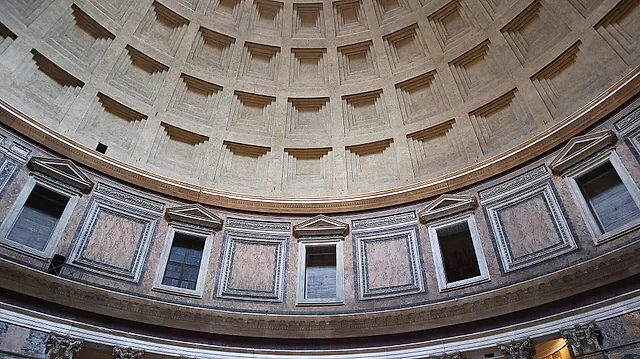
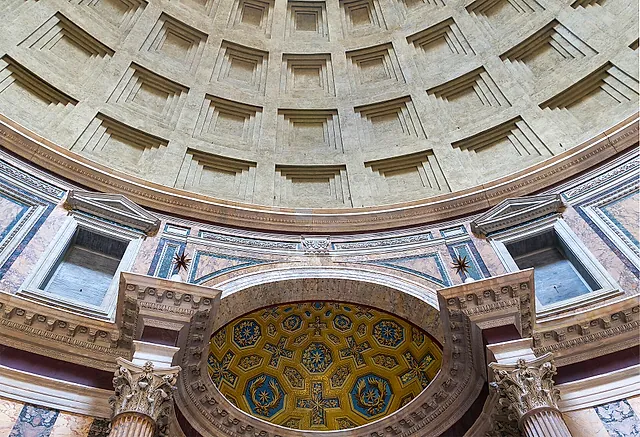
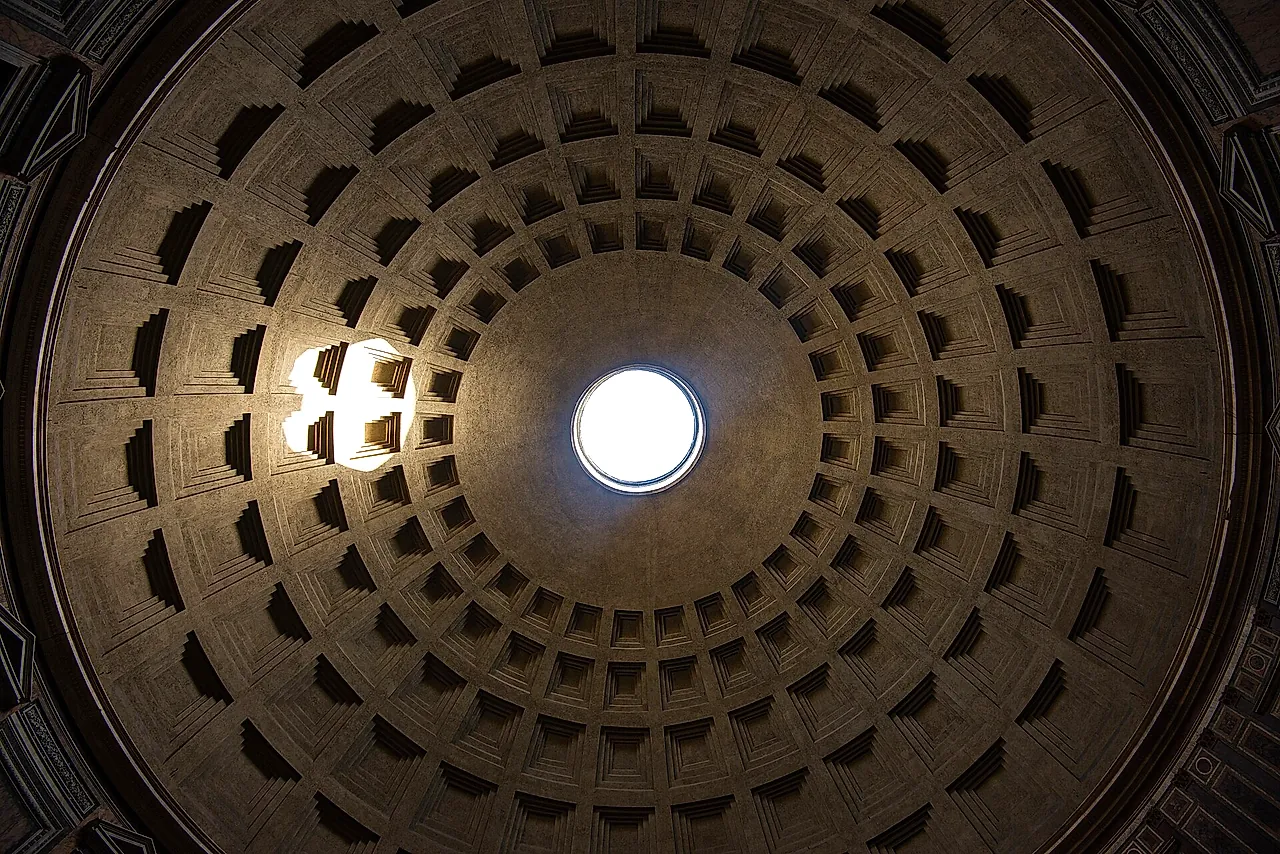
Step in and look up. The rotunda is 43.3 metres wide and 43.3 metres high, so a sphere would fit inside it exactly. The dome is the largest in the world made of unreinforced concrete. It is thick at the base, about 6.4 metres, and thin near the top, about 1.2 metres, and the builders used lighter materials, such as tuff and pumice, as the dome rose. The ceiling has five rings of 28 coffers.
At the top, the oculus is about 9 metres wide. Follow the beam of sunlight as it moves across the walls. On 21 April, the traditional date of Rome’s founding, a circle of light falls on the great doorway around midday. In the rain, water falls through the opening onto a floor that slopes slightly, with 22 almost invisible drains.
Where are the tombs?
The best known is Raphael’s. The painter died on 6 April 1520, and his sarcophagus stands in a niche on the left side of the church. The Latin epitaph was written by Cardinal Bembo. Next to it lies Maria Bibbiena, who was engaged to Raphael. The statue of the Madonna above is the Madonna del Sasso, which Raphael himself wanted.
On the right side of the church you find the chapels of the kings of Italy. Victor Emmanuel II died on 9 January 1878, and Umberto I was assassinated on 29 July 1900. Queen Margherita of Savoy rests with him. Other artists are buried here, including Annibale Carracci, Baldassarre Peruzzi and Arcangelo Corelli.
What is the altar and the apse?
The Pantheon is the church of Santa Maria ad Martyres, and Mass is still celebrated here. The altar and the apse stand opposite the door.
What can you see outside?
In Piazza della Rotonda, the fountain was built in 1575 and the Egyptian obelisk of Ramesses II was set on top in 1711. Behind the rotunda stands the Basilica of Neptune, part of the same complex that Agrippa built. Since November 2025 it can be visited on a special 45-minute tour. It is a separate visit from the Pantheon ticket.
Nearby, Santa Maria sopra Minerva is about 150 metres away. It is a Dominican church begun in 1280, with a Christ by Michelangelo from 1521, and in the square in front of it stands Bernini’s little elephant, carved by Ercole Ferrata in 1667. For more distances, see the getting there page.
Is there a special day to visit?
On Pentecost, which falls on 16 May in 2027, rose petals are dropped through the oculus at the end of the celebration. The time and the access that day are not confirmed, so check before you plan. For the story of the building, read the history of the Pantheon, and for the tickets, the tickets guide.