Short answer. The Pantheon was begun by Marcus Agrippa as a temple around 27 BC. The building you enter was raised in the early second century, in the time of Hadrian. It became the church of Santa Maria ad Martyres in 609, and that is why it is still standing.
Tickets, guided visits and walking tours
Pantheon Rome: Entry Ticket + Digital Audio Guide
3.7· 7,723 reviews
from €11.80
Book tickets and tours →Who built the Pantheon?
The first temple was commissioned by Marcus Agrippa, the son-in-law of Augustus, between 27 and 25 BC, as part of a group of buildings on the Campus Martius that also included baths and the Basilica of Neptune. Fire damaged it in the years 80 and 110.
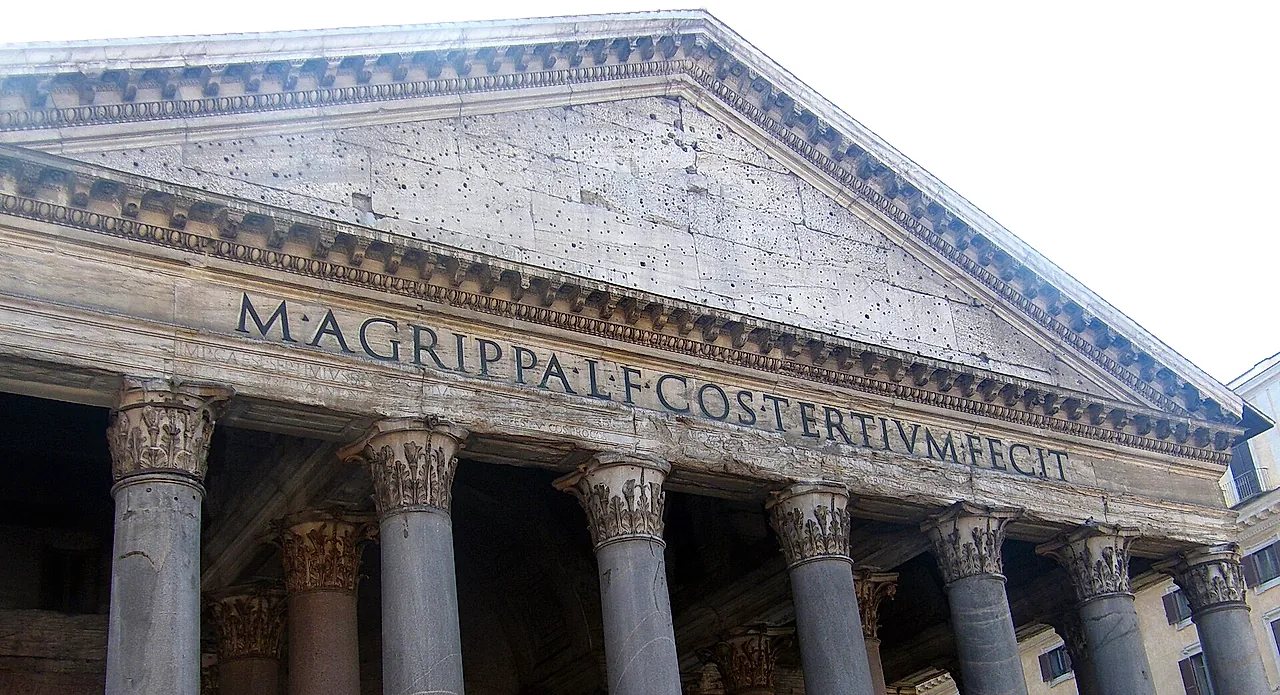
The temple you see now was rebuilt under Hadrian. The date is uncertain: it was probably finished in the first half of the second century, and scholars argue about the exact years. The name of the architect is not known. One hypothesis points to Apollodorus of Damascus, but it remains a hypothesis. The inscription on the front still says that Agrippa built it. In 202 Septimius Severus and Caracalla restored the building, and a smaller inscription records it.
Why is it called the Pantheon?
The Roman historian Cassius Dio offers two explanations. The temple may have held the statues of many gods, or the dome may have looked like the sky. Scholars think the name was probably a nickname for the building.
How did the temple become a church?
In 609 the Byzantine emperor Phocas gave the building to Pope Boniface IV. On 13 May the pope consecrated it as the church of Santa Maria ad Martyres. Tradition says he had twenty-eight cartloads of the bones of martyrs brought here from the catacombs.
Being a church saved the Pantheon from the fate of many Roman temples, which were stripped for materials. Even so, it lost its roof of gilded bronze tiles in the seventh century, when the emperor Constans II took them away. Later, Pope Gregory III covered the dome with lead in the eighth century.
What happened to the bronze of the portico?
In the seventeenth century Pope Urban VIII Barberini had the bronze removed from the portico, from the beams that held up the roof. The Romans answered with a famous saying put on the statue of Pasquino: “What the barbarians did not do, the Barberini did.”
The legend says the bronze went into the great canopy of St Peter’s by Bernini. When a scholar checked the papal accounts, he found that about nine tenths went to cannon for Castel Sant’Angelo, and that the bronze of the canopy came from Venice. Two bell towers, nicknamed the donkey’s ears, were added in the seventeenth century and were taken down in 1883.
What is inside the Pantheon?
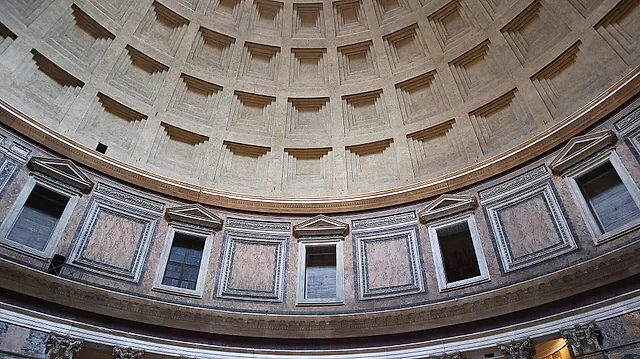
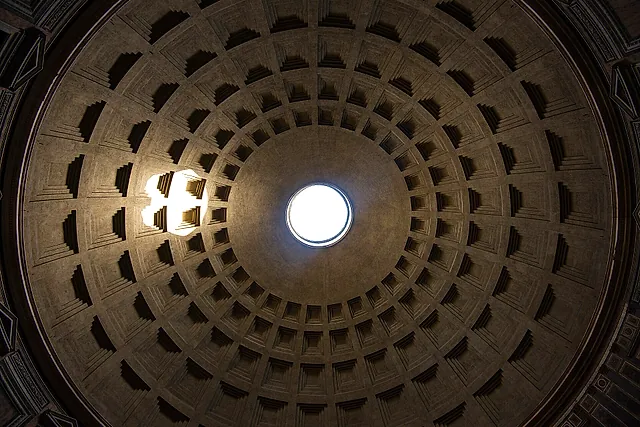
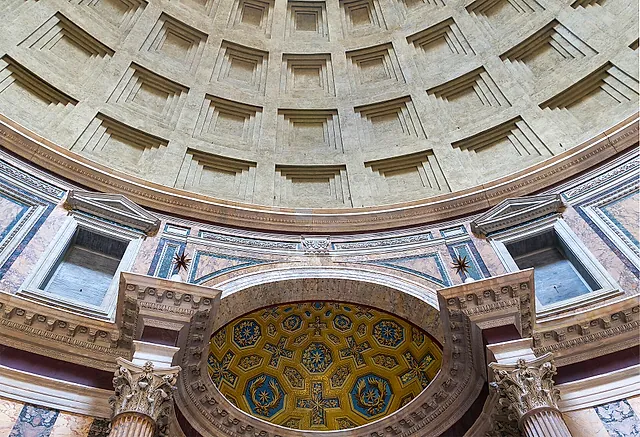
The rotunda is 43.3 metres wide and 43.3 metres high. The dome is the largest in the world made of unreinforced concrete, and the oculus at the top is about 9 metres across. In 1747 the decorated band under the dome was covered in lime during a restoration. Other restorations followed in the 1920s and 1930s, and again in 2004 and 2005.
After 1870 the Pantheon became the burial place of the kings of Italy. Victor Emmanuel II died in 1878 and Umberto I was assassinated in 1900, and both lie here. Raphael had been buried here since 1520.
You can read more about each part in what to see at the Pantheon, and plan your visit with the tickets guide and the hours and directions.